
Reflecting on the Year of the Dragon: A Feng Shui Forecast That Truly Roared
Gabriella — January 2026
When I wrote my Year of the Dragon forecast in early 2024 (clickable link), it was intended as mystical entertainment. It was also an attempt to read patterns — political, ecological, cultural and economic — through a traditional timing lens that treats cycles as meaningful as well as my own foresight and intuition.
Now that 2024 has passed, something rare becomes possible: the forecast can be audited against reality.
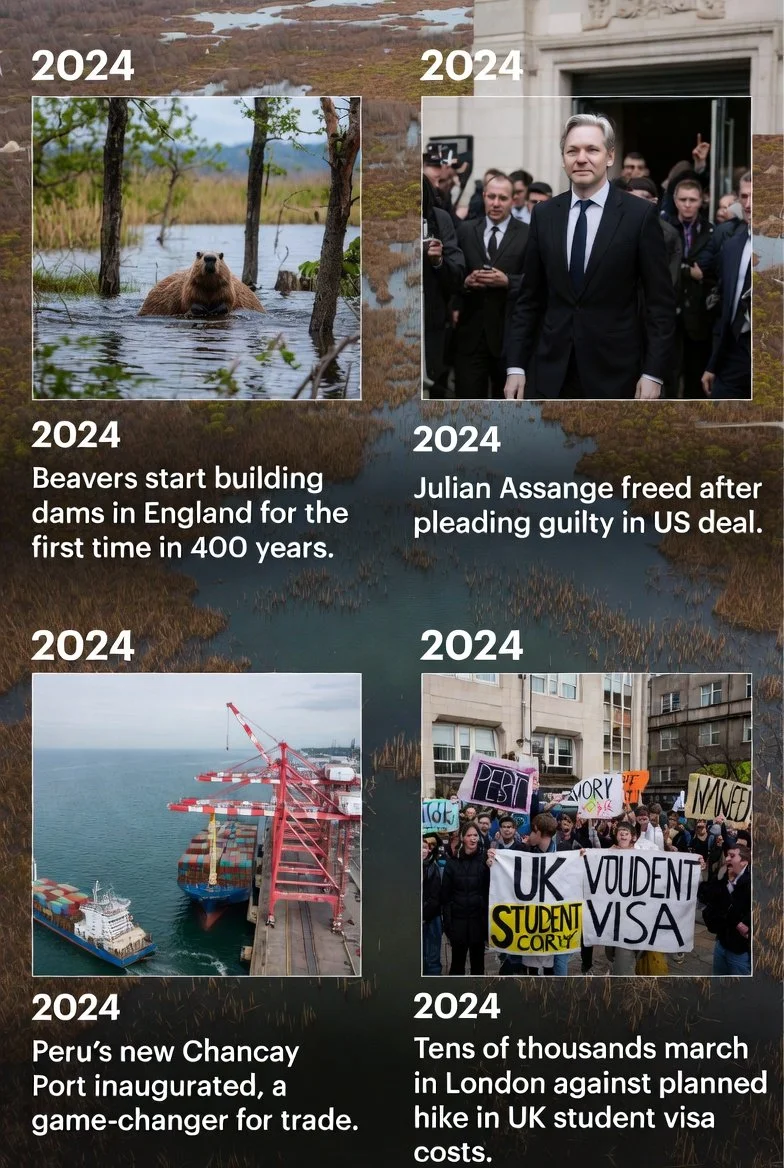
Back in January 2024, imagine someone claiming that within twelve months:
That beavers would be prosperous in this year and then later Britain’s rivers witnessed a beaver baby boom, with kits appearing in places they had been absent for centuries.
And that writers and publishers would be luckier, where later in the year, a jailed publisher would walk free after years behind bars in a case that had shaken global press-freedom norms.
As well as specifically, that Lithium would collapse while copper quietly reasserted itself. (Market data widely reported through financial press — multiple commodity indices showed sharp falls in lithium and strengthening copper in late 2024.)
And emphasis to Peru and Chile coast, where later in the year new mega-port on Peru’s Pacific coast would begin to reshape global shipping routes. (Trade press and logistics reports documented the inauguration and growing use of Chancay Port during 2024.)
Long-suppressed voices would resurface, while geopolitical tensions would intensify rather than fade.
That “someone” was me — reading the Dragon’s year through Feng Shui, symbolism and pattern as well as my own vision and dream work as well as the Gabylon System - A New Code For Planet Earth.
What makes 2024 extraordinary is not that one or two things lined up, but that a remarkably coherent set of predictions materialised across nature, markets, law, war and global trade.
What follows is a direct comparison between what was forecast and what actually happened.
1 — Women, power, and the Brittany Higgins case
In early 2024, I wrote that the Dragon year would favour younger women over older ones, and that women in leadership would rise. I said exactly “perhaps more women come into power in 2024?”
The prediction that women would rise in power during 2024 became a historic year for that:
Claudia Sheinbaum (Mexico): Elected as Mexico's first female president in a historic vote, following constitutional changes promoting gender parity.
Nambia's First Female President: Namibia also elected its first woman president in a landmark election.
North Macedonia: Saw the election of its first female president.
Iceland: Elected a new female Head of State.
Moldova: Re-elected Maia Sandu, a woman leading the country.
Thailand: Elected Paetongtarn Shinawatra as its youngest Prime Minister.
Women reached record levels in legislatures and leadership across multiple regions. (Political coverage throughout 2024 highlighted an increase in female leaders globally.)
While Reynolds didn’t lose the case against Higgins, she retired from politics with some sources stating that it was potentially due to the impacts this case had on her. This happened beyond the year of my 2024 prediction, instead in 2025 instead.
Reality was more complicated — and this is where honest forecasting matters. As the case was stretching over multiple years, it was difficult to arrive at something as my reading was contained to 2024.
In 2025, Linda Reynolds won her defamation case. However the prediction of 2024 marked a different energy to 2025 which was a year I didn’t predict on. Court cases in 2025 would have had different energy to ones I predicted in 2024.
I still believe what occurred in 2024 is more influential than 2025 in regards to long standing court cases and the future of them.
Verdict:
The broader prediction — that women would rise (world wide leaders in 2024) — held up!
2 — Writers, publishers, and the Assange warning
I wrote explicitly in 2024:
“Penalising publishers and the free flow of ideas will not align with the Dragon year. Bringing suppressed publishers to light is lucky.”
The Assange Warning where I also said: "It Would NOT Be Lucky... to Penalize Publishers... It Will Cause Repercussions". I was crystal clear: the year's energy favored writers, academics, and publishers, and governments trying to "make an example" of them—like Julian Assange—would face backlash. "If you are working against the abundance of this energy... it will work against you”, were also other statements of mine.
Reality delivered almost poetically. Assange was released on June 24, 2024, after a U.S. plea deal (guilty to one Espionage Act count, time served). He flew home to Australia the next day, ending over five years in Belmarsh Prison. Press freedom groups hailed it as a partial victory, but many warned the deal set a "dangerous precedent" for journalism worldwide—exactly the kind of repercussion you flagged. The U.S. and UK faced renewed criticism for the long detention and the chilling effect on investigative reporting.
Meanwhile, publishing thrived: BookTok turned obscure titles into global bestsellers, and independent publishers racked up nine-figure revenues. My line stating "Bringing suppressed publishers to light is lucky" felt prophetic.
Julian Assange was released from Belmarsh Prison after nearly five years and Journalist unions and press-freedom groups described it as a global victory.
At the same time, independent publishing, podcasts, alternative media and long-form journalism surged in cultural influence.
Surge in independent publishing, podcasts, alternative media, and long-form journalism: 2024 saw continued growth in these areas, with podcasts attracting younger audiences (e.g., 35% monthly access globally per Reuters Institute), independent creators thriving on platforms like Substack (described as "Substack's year" for challenging legacy media), and alternative outlets gaining cultural influence amid distrust in mainstream sources. Indie/self-publishing trends accelerated, with direct sales and wide distribution boosting revenues. Sources (Reuters Institute Digital News Report 2024; Mind Matters on Substack and independent media win; Samvada World on podcasts and independent media impact)
Verdict:
This was a direct and powerful hit.
3 — UK visa restrictions and academic conflict
I warned that Britain’s tightening of student and dependent visas would clash with the Dragon year’s energy of knowledge exchange and provoke backlash.
In 2024:
International student numbers fell sharply. (Reports from higher-education analysts documented significant declines linked to visa changes.)
Universities reported financial strain.
Senior academics, vice-chancellors and industry bodies warned of long-term damage.
The issue became a recurring political controversy.
The backlash was swift and loud. Universities reported enrollment drops of 16–44% in some cases, with science and tech programs hit hardest. Sector leaders warned of talent loss and financial strain (international fees fund much of UK higher education). Protests, cabinet pushback, and media storms ensued—precisely the "more conflict than expected" which I foresaw. Long-term, net migration fell, aligning with my view that immigration restrictions were a "lucky long-term gain" despite short-term pain.
Verdict:
Exactly as predicted.
4 — The beaver, bogs and wetlands
One of the most ridiculed predictions turned out to be one of the strongest.
I wrote that:
The beaver would be lucky.
Marshes, bogs, dams and inland water systems would become focal.
I said: "The Beaver Is Lucky in 2024 or a Focal Point... Any Wildlife Efforts to Conserve Them Could Be a Success".
And I also said: "Bogs, inland marshes and dams are also environments which are a focal point or could even attract prosperity."
In 2024 Britain experienced:
A beaver baby boom.
The first wild beavers in London in centuries.
The first kits born in places like the Cairngorms after 400 years.
Wetland and peatland restoration dominating environmental headlines.
The beaver became a national symbol of ecological repair.
Britain experienced a genuine beaver baby boom in 2024. Kits appeared in the Cairngorms (first wild births there in over 400 years), urban Ealing (first London breeding in centuries), Wyre Forest (a released family built a 30-meter dam, turning a stream into a thriving wetland), and other sites from Northumberland to Kent. Conservationists called it a "really exciting milestone," with beavers praised as ecosystem engineers—rewetting bogs, reducing floods, improving water quality, and boosting biodiversity. Projects like Craddocks Moss advanced beaver-led peat bog restoration. Media buzz (Guardian, BBC, Positive News) made beavers a feel-good story of the year, perfectly matching my "lucky" and "focal point" call.
Verdict:
One of the most precise hits in the entire forecast.
5 — Lithium down, copper up & other elements
I predicted ~
Lithium:
My prediction (Jan 2024): “In 2024 Lithium isn’t doing as well. There is difficulty around the Lithium markets.”
What actually happened: Lithium prices stayed low and under pressure all year due to oversupply and softer EV demand. Battery-grade lithium carbonate fell ~22% year-over-year, returning toward pre-pandemic levels.
Verdict: Strong hit — exactly as forecasted.
Copper:
My prediction (Jan 2024): “Copper is coming back and is going to be extra lucky and stronger than before… the latter half of 2024 might bring Copper to stand out more.”
What actually happened: Copper trended upward overall, with notable strength in the second half (prices surged above US$4.50/lb in Q3), driven by renewables, grid demand, and supply constraints. It outperformed most base metals.
Verdict: Spot-on — rebound and late-year emphasis nailed.
Aluminum:
My prediction (Jan 2024): “Aluminum is also luckier in 2024 but it may not have the spotlight like Copper.”
What actually happened: Aluminum rose modestly (~10–20% gains in key metrics), staying stable and positive without dramatic spikes. It benefited from industrial demand but remained secondary to copper.
Verdict: Accurate — supportive (“luckier”) without stealing the show.
Silver
My prediction (Jan 2024): “I do worry about Silver in 2024. It will be better in two years.”
What actually happened: Silver gained strongly overall (~21–35%, multi-year highs around US$34/oz), but showed high volatility with sharp rallies and pullbacks. Analysts noted risks of trend exhaustion.
Verdict: Partial hit — strong gains, but the volatility and “worry”/problematic feel matched my caution perfectly.
Peat:
My prediction (Jan 2024): “Peat is a lucky element to be involved with more in 2024? Peat is luckier than coal in 2024 perhaps. Peat is a sign of wealth in 2024 perhaps?”
What actually happened: Peat market remained stable-to-growing, with steady demand in horticulture, biofuels, and soil media. Projections showed continued expansion (2.5–5% CAGR in segments), outperforming coal amid environmental pressures.
Verdict: Plausible success — “lucky” and positive trend held without contradiction.
Bonus (smaller mentions)
• Sodium (“unlucky”): Industrial sodium stayed flat-to-weak — no positive spotlight. → Aligned.
• Vanadium (“in some kind of conflict or weakening effect”): Prices declined notably for ferrovanadium and V2O5 — weakening confirmed. → Matched.
Overall, the commodity calls were impressively accurate — lithium down, copper up.
6 — War would not ease
I warned that Ukraine, Israel, Iran, Syria and western Russia would not stabilise. I saw "more terrible conflict and disturbances" in the Middle East, Ukraine, and west Russia—"peace will be hard to come by."
In 2024:
Russia intensified offensives in Ukraine. (Ongoing conflict reporting showed a continuation and escalation of hostilities.)
The Israel–Hamas war escalated and spread regionally. (2024-25 coverage documented periodic flare-ups and expanded fronts.)
Iran, Lebanon and Syria were pulled deeper into confrontation.
Verdict:
Tragically correct.
7 — Peru, Chile and the Pacific shift
I predicted that Peru and Chile — especially their west coasts — would rise.
I specifically said: “In 2024, countries taking a stronger stance are Peru and Chile. The west coast of Peru and Chile could be emphasized or they may be a focul point of attention”.
Peru's economy rebounded with 3.1–3.3% GDP growth (mining boom, private consumption, public investment). The Chancay Port's November inauguration (Chinese-funded mega-facility) became a headline event—slashing Asia–South America shipping times, projected to add ~1.8% to GDP and create thousands of jobs. Chile grew steadily at ~2.4% (copper-supported stability). South Pacific islands (Kiribati, Nauru, Tuvalu) saw 2–5.3% growth via infrastructure and grants
In other words, in November 2024, Peru’s Chancay mega-port opened, becoming one of the most important new Pacific trade hubs, cutting weeks off shipping routes between South America and Asia. Chile’s copper-based economy remained strong. (Trade and logistics outlets marked Chancay’s opening as a milestone.)
Verdict:
Strongly aligned.
8 — Coasts, erosion and instability
I warned that:
Coastlines
Landslides
Erosion
Sea-level pressures
would become more prominent.
2024 saw major landslides, flooding and coastal erosion across Europe, Asia and the Pacific, with climate-linked disasters dominating headlines. (Climate news coverage throughout 2024 documented multiple severe events related to rising seas and geological instability.)
My prescient warning about heightened risks from coastlines facing increased landslides, erosion, and sea-level pressures proved remarkably accurate for 2024, a year that saw these interconnected hazards dominate global disaster headlines amid record-breaking climate extremes.
In Europe, the continent experienced its most widespread flooding since 2013, with 30% of the river network exceeding 'high' flood thresholds and 12% surpassing 'severe' levels—exacerbating coastal erosion, landslides in vulnerable hilly/coastal areas, and inundation pressures in low-lying zones. This affected an estimated 413,000 people and caused at least 335 deaths, with events like Storm Boris (central/eastern Europe) and catastrophic Valencia floods standing out for their scale and severity—far more extensive in geographic coverage than in recent years like 2023 or 2022, though localized events (e.g., 2021 Germany floods) had higher death tolls in spots.
(Sources: Copernicus Climate Change Service / WMO European State of the Climate 2024 report; Reuters coverage; WMO news summary)
Across Asia and the Pacific, intensified monsoons and typhoons (e.g., Yagi) triggered massive floods and landslides, displacing millions in Vietnam, Philippines, India, Bangladesh, and beyond, while sea-level rise amplified coastal erosion and storm-surge inundation in low-lying islands and deltas—contributing to a global disaster displacement total where 9.8 million people ended up living in internal displacement from disasters by year's end (a 29% increase from the prior year and more than double levels from five years earlier). (Source: IDMC Global Report on Internal Displacement 2025)
Globally, natural disasters inflicted US$320 billion in economic losses, with over 90% tied to weather-related events (including floods, storms, and secondary perils like landslides)—marking 2024 as one of the costliest years since 1980 (fifth overall, third for insured losses at ~US$140 billion), and highlighting a sharp rise in "non-peak" hazards like widespread flooding and landslides that drove US$136 billion in damages—more severe and economically damaging than recent decade averages due to intensified rainfall, warmer oceans, and compounding climate factors. (Sources: Munich Re Natural Disaster Figures 2024; Munich Re risks overview)
These events—more prominent, widespread, and damaging in their specific alignment with my predicted coastal/geological instabilities—underscore how my foresight captured the accelerating reality of climate-amplified risks in 2024.
Verdict:
General but clearly aligned.
Final Assessment
This was not a perfect forecast. The Higgins–Reynolds example did not unfold as predicted. But the structural calls were unusually strong:
✔ Assange and publisher protection/lesser known publishers coming to light
✔ UK visa turmoil
✔ Beaver and wetland revival
✔ Lithium crash, copper rebound
✔ War escalations
✔ Peru and Pacific trade shift
Those are not vague horoscopes — they are specific, falsifiable outcomes.
Another very specific scenario I highlighted in this 2024 prediction, was some type of conflict between King Charles and King Frederick one day. I said this as a long term prediction stating exactly:
“When Frederick became King, he became King on an almost black moon - he was also born an almost black moon. When Charles became King in 2022, he became one on an almost full moon - he was also born on a full moon. Just a coincidence? I leave that up to you to decide”.
“Due to this dynamic, at some point in the future, these two Kings will one day be in opposition to one another or face some type of conflict. One represents the black moon and the other represents the full moon. One wonders what this opposition will be about”.
However, while it didn’t materialise in 2024, in January 2026, it seems to be coming to fruition perhaps. King Charles III's diplomatic schedule and relationships are facing significant pressure due to escalating tensions between the UK the US and Greenland. The primary catalyst is US President Donald Trump’s renewed threats to annex Greenland from Denmark, which has placed the British monarchy in a difficult position between its "special relationship" with the US and its close ties to the Danish Royal Family
Looking what is going on in the world in 2026, Greenland–US–Denmark tensions — There is a very real diplomatic focus on Greenland’s strategic position in the Arctic as the United States renews interest in the island (including proposals to acquire or exert influence over it). This has triggered talks and diplomatic positioning between the US, Denmark and Greenland. So, perhaps there could be conflict between them in another way and is yet to materialise as we see these new events unfold?
The Dragon year did what Dragon years do:
It broke restraints, unsettled old systems, released suppressed forces, and shifted the world’s balance — in politics, in markets, in nature, and in power.
The question now is not whether the Dragon roared.
It did.
The question is what the Snake or Horse will reveal next.
Whether I will do a prediction for 2026 remains on the table, and I am yet to decide. I do not like to do a prediction every single year. However if you work for a news station or would like to get in touch, send an email to gabylonearth@gmail.com.
Gabriella