
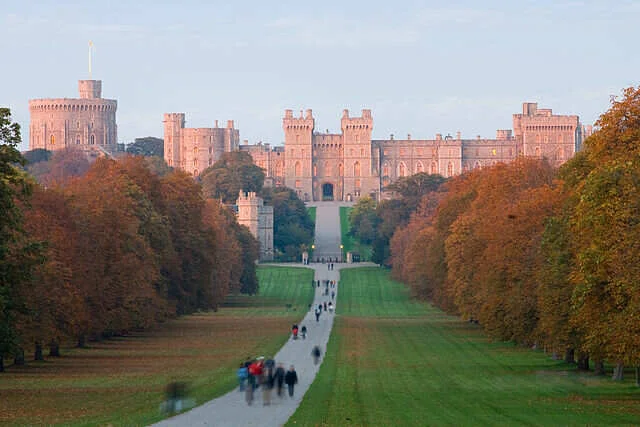
Feng Shui for Windsor Castle – Fit for a Queen, and sometimes a King

Visit Windsor Castle here https://www.rct.uk/visit/windsor-castle
This Article on Windsor Castle is Officially Copyright Protected © Feb 2015 and was updated in January 2026
Why Did I Choose Windsor Castle as a Case Study?
Windsor Castle is the oldest castle in the world. It is also the Bastion of English Royalty.
Because of this I believe, in Feng Shui, even if the Royals do not live here permanently, and perhaps only sometimes visit, this Castle in particular has an overall magnetic influence over their lives, more than any other Castle, whether they chose to believe it or not. It is a bit like a stain on a cloth that cannot be removed. This is simply because the importance of this castle to the royal lines, how long it has been around for and the very strong connection it has to their origins. It is a hard concept for a modern, scientific mind to accept, but somehow all like-things are connected.
The Feng Shui Reading of the Castle grounds, reveals that this Castle is fit for a Queen and not always a King. The property favors women as rulers not men, however there is the exception, if certain male heir become King’s on full moons or have the full moon well placed in their chart, perhaps they may be luckier.

This Circular Moon Phase which comes out of Gabylon Philosophy (circular/alternative science system delving deeper into belief systems ™) and placed over houses to ascertain the cosmic luck around buildings and occupants. A map of Windsor Castle shows that its northern sector aligns with full moon energy. In Feng Shui, this area is known as the sitting position, or “backbone,” which provides stability and support to the occupants. Once correctly identified using compass direction and classical Feng Shui principles, this sector aligns with a specific moon phase that acts as an energetic guardian. Overlaying a moon phase wheel and colour wheel onto a property plan is a method I developed through the Gabylon System
Windsor Castle's sitting direction (its "back" or spine, opposite the facing/front) is in the north sector, known in Feng Shui as the most feminine and receptive energy area. This northern position aligns with the full moon at 100% illumination—the peak of yin/lunar power.
The sitting direction or sitting segment, acts as the building's backbone, determining how it energetically supports and protects its occupants (especially rulers). A northern sitting orientation like this generally favors feminine energy and female leaders. The moon itself embodies yin qualities that are more harmonious with women than men. That said, it doesn't prevent kings from succeeding—many have thrived—but the castle's core energy naturally leans toward empowering queens and feminine archetypes
Each sitting position of a property’s plan (calculated by geometry and a certain philosophy) is associated with a particular moon phase, which influences the quality of support and stability experienced by those who inhabit or rule from the space. In the context of the British monarchy, Windsor Castle plays a defining role in how a reign is supported. As the longest continuously occupied royal castle in history, its energetic orientation has a significant influence on royal fortune and success, varying according to the individual ruler and the timing of their reign and whether they are a man or a women.
Every property will govern a certain phase of the moon depending on its sitting direction which is determined by using a compass and drawing a perfect circle around the entire property. This moon phase can be used to determine (in a general sense) the luck of certain occupants who live there by their birth and when they become rulers.
Windsor Castle is governed by the Full Moon Energy due to its sitting direction.

In general, that the feng shui energies suggest female rulers lean towards a far greater capacity to bring wealth to the monarchy, much more than a King. However there is always the exception, a man with the full moon placed well in his chart may succeed in his reign here.
These primal oppositions define existence: man and woman, black and white, light and darkness, rich and poor, gentle and fierce, sun and moon, youth and age. Yet few structures embody perfect equilibrium. Many tilt toward one polarity or the other—as seen at Windsor Castle, where an unmistakable energetic favoritism leans toward the feminine, the full moon lunar, the receptive.
Depending on the construction year and facing position of a property determines its energy also, and governs more events and situations within the palace. Because Windsor Castle grounds, has many buildings added within it, in so many different periods of time, over the last 1000 years, this could make the task of a feng shui reading quite difficult. The overall picture is key.
In a Flying Star Feng Shui Reading, the Construction Period of a property is crossed over with the Facing Direction. From this 8 paired number combinations, will be distributed over the castle grounds into different “slices” of the magnetic compass.
Each number will represent an element, (Fire, Wood, Water, Earth and Metal). Each number will also govern a different member of the family (6 = father, 2 = mother, 3 = eldest son, etc..).
If a property is built in a certain period of time, it will always house those energies associated with it's time frame and will affect the occupants at certain degrees no matter what time they pass through.
For a Castle as important as Windsor Castle, this will have a heavy influence on the royal family and future generations.
William the Conqueror started building the Windsor Castle in 1070 and it was finished 17 years later. If my calculation is correct, the original Windsor Castle grounds was constructed in Period 6. However now I follow another system, and this may not be correct.
In the 1170s, King Henry rebuilt the castle, replacing wooden structures with stone walls—a major transformation. Such a rebuild resets the castle’s construction period under the feng shui calendar (depending on the system used). Nonetheless, Flying Star feng shui remains a useful divination tool.
With my studies on the Gabylon system, other forces, such as the moon phase wheel, offer a more simple explanation as to why some rulers seem to fair better than others.
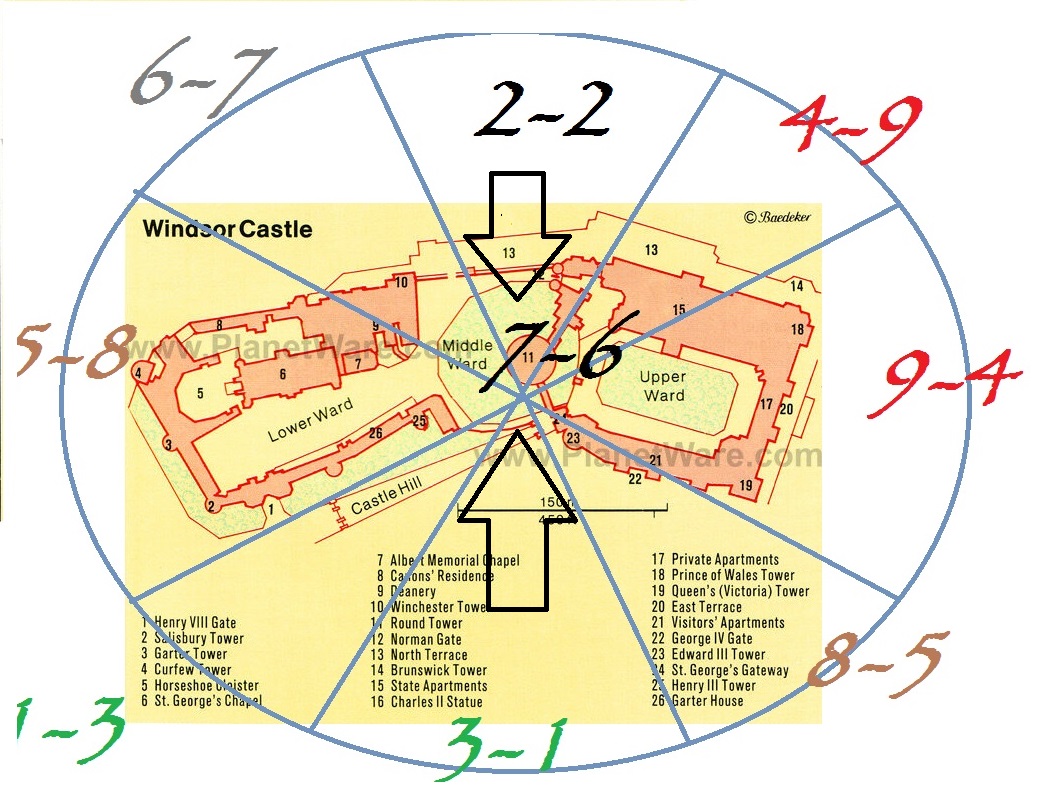
Back to Flying Star Feng Shui, with a double 2-2 in the North (as seen in the below diagram), there is emphasis to women holding longer reigns or ruling successfully.
Two 2s paired together symbolically in the North suggest intensified maternal energy, pointing clearly toward female rulership rather than male dominance.
I believe flying star feng shui system, which employs paired numbered philosophy (I feel this system has limitations) yet can be interesting however not always accurate.
The Sitting Direction of a Property, Backs up and Supports

The flying stars generated from the period of around 1170 may look like this.
Moon Phases and their effects on royals
The core method of this lunar-royal analysis involves examining two key moon phases for each figure: (1) the exact phase of the Moon at the moment of their birth (reflecting their innate "lunar self" or foundational energy), and (2) the phase of the Moon at the precise instant they become monarch — defined not by the later ceremonial coronation, but by the actual moment of accession, which occurs immediately upon the death (or abdication) of the predecessor. This accession moment is viewed as the true energetic threshold when the royal assumes sovereign power and aligns (or conflicts) with Windsor Castle's purported Full Moon–supported orientation.
King Henry VII (Seventh): The Near-Full Moon Sovereign – Architect of Enduring Success
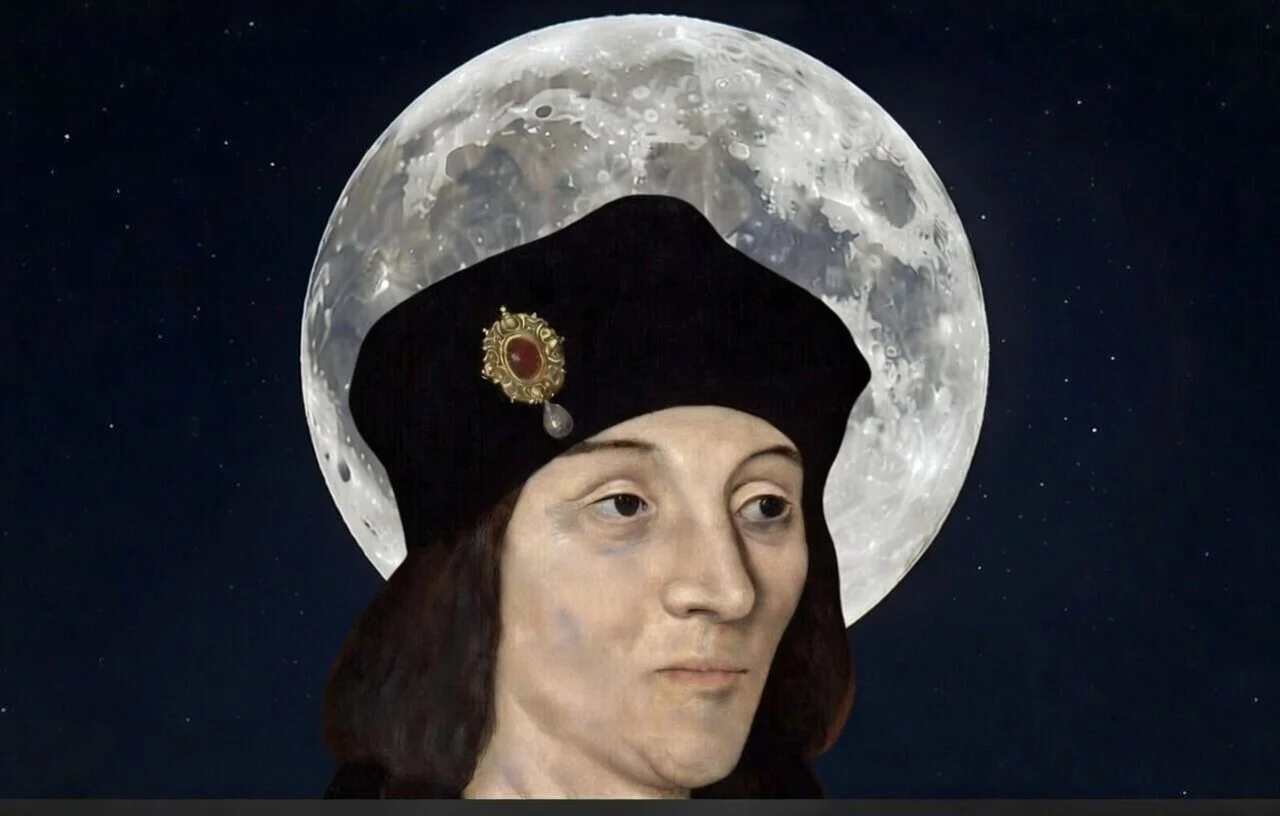
Was King Henry the Seventh a Successful King? Yes he was!! He was an exemplary King. He built up the monarchy and created so much wealth, that literally when he died, his son King Henry the Eighth walked onto a ‘stage’ that his father had created for him.
While King Henry the Seventh was not born on a full moon, yet he was born a very skinny moon which was only 3 days old, however he became King on almost a full moon (85% illuminated), the 22nd August 1485. When someone becomes a ruler, it is like a rebirth and so the timing of this can influence success or disaster. On this day, the moon was 11.97 days old and 85.91% illuminated. So the moon was still quite large and big (almost full). I believe that the fact that he became King on such a moon, gave his reign more luck. Even though it was still a declining moon or wanning moon, it was still large enough to support and back him up.
As the full moon stands behind the castle as the backing up force—and in the same way, it will stand behind (or support) the occupants when the full moon encircles them, as we can see now with an almost full moon on the day King Henry the Seventh became King.
King Henry the Seventh was a very smart man, more than other male monarchs, however he was faced with many powerful and wealthy English Barons, those who had their own private armies which were a threat. King Henry the Seventh banned all private armies and introduced the death penalty to Baron’s if they objected. He also heavily taxed the Barons so their wealth would be weakened.
Henry VII stood apart from most preceding monarchs by treating royal finances as a personal priority rather than a noble or clerical concern. He believed firmly that “a rich king was a strong king,” and that wealth enabled him to maintain and expand a loyal army—crucial for intimidating or suppressing baronial unrest after the Wars of the Roses. Through strict accounting, heavy taxation on the nobility, and instruments like bonds and recognizances (which forced lords to behave or forfeit money/lands), he amassed one of the largest royal fortunes in medieval English history. This prudent legacy gave Henry VIII a powerful head start: a solvent treasury, a stabilised realm, and a strengthened Tudor position that underpinned his long and transformative reign. – source “Henry VII” HistoryLearningSite.co.uk
King Charles III: The Double Full Moon Sovereign – Herald of Wealth and Enduring Fortune

A.I Grok Image inspired by portrait of King Charles / Artist Jonathan Yeo
King Charles the Third, as well as being born on a full moon (14th of November 1948) with 95% illumination, also became King on the 8th of September 2022 with an 90% illuminated full waxing or growing moon, an almost full moon as well.
The energy of Windsor Castle will personally back him up alot more than other male monarchs and enhance his leadership, especially if he is physically present in the castle at key moments for luck. So far we know that King Charles has attracted far more financial luck than the late Queen Elizabeth. According to The Sunday Times Rich List in 2025, King Charles's personal fortune is estimated at £640 million (roughly $850-$860 million), which is nearly double the £370 million ($493 million) valuation of Queen Elizabeth's personal wealth at the time of her death in 2022. In addition, while he as been on the throne, Sovereign Grant increased to 138 million whereas years prior it had been 86.3 million.
With a double full moon each for birth and reign, it is quite symbolically special. His presence brings luck to Britain overall and its government. During his time, I feel he will achieve much. It is also suggestive of potential luck with expanding territory, or securing resources, in some way which grow and hold lasting impact. His reign may symbolise a changing time for the UK, its government and people, in a way that allows future growth and success.
Henry VIII (Eighth), the Double Half Moon King: Bearer of Divided Fate and Shadowed Luck

King Henry the Eighth was born on a half moon and became King on a half moon
King Henry the Eighth (who was King Henry the Seventh’s heir), who didn't attract wealth to the monarchy like his father did, only attracted great fame and stood out in history because of his successful attempt to break away from the Catholic Church and not only that, he married six times and executed two of his wives. However he is remembered for being the ‘Father of the Royal Navy’ as he expanded it significantly, overseeing the construction of famous ships.
In fact King Henry the Eighth, almost bankrupted the royal treasury. Did he have the full moon around him like his father? No he didn’t as he was born on June 28th, in 1491 - which means he was born on a half lite waxing moon (only 50% illuminated). He became King on April 22nd, 1509, which was also half waning moon (again only 50% illuminated). The full moon energy governed by Windsor Castle did not support him perhaps due to this weakly illuminated moon activated around his reign.
Another royal born on similar placement, is Prince Andrew, for birthday the 19th of February 1960, beneath a half moon—around 50% illuminated and already in its waning phase. Given the sustained media attention, the removal of titles, and his recent relocation to more modest lodgings, it almost feels as though Windsor Castle’s long-held influence has quietly withdrawn its support over time, for someone like him under this aspect.
The Full Moon Monarch: Queen Elizabeth the First, Architect of Unparalleled Luck and Golden Triumph
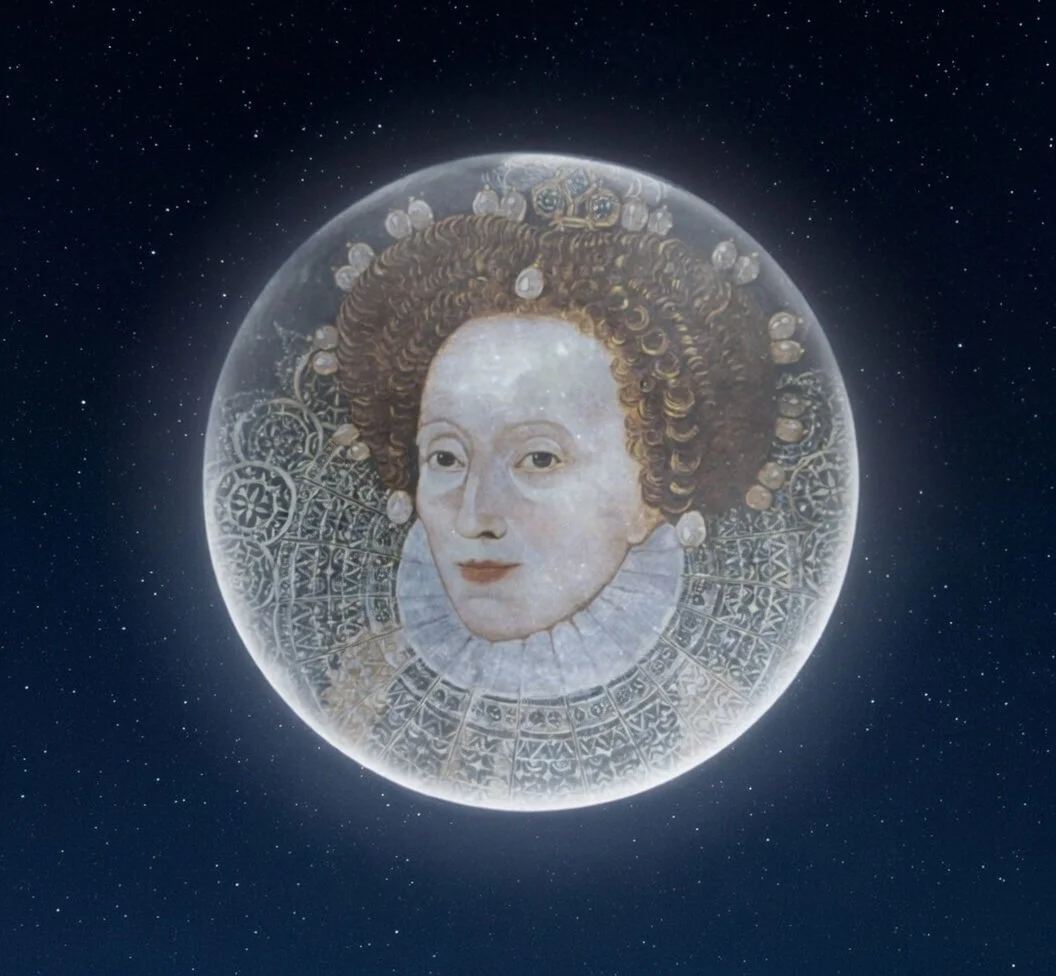
It was King Henry the Eighth’s daughter, who was born On 7 September 1533 with 95% illumination (full moon) with Queen Elizabeth the First, who eventually took the throne and established wealth back into the monarchy, she attracted so much wealth in fact, that her reign became more famous than any other reign; it was called ‘The Golden Age’. Queen Elizabeth the First reigned between 1558 and 1603 - an exceptionally long time. She became Queen on the 17th of November 1533 which was a half waxing (50% illuminated moon). It didn’t matter as she was a women and born on a full moon, so naturally the luck of Windsor Castle supported her as it favours women.
When you think about it, there is no King in the English monarchy that ever had a reign which was worth calling the ‘Golden Age’.
Mary Queen of Scots - Ruler of the Black Moon (The dark lunar force opposing Elizabeth's radiant full-moon reign.)
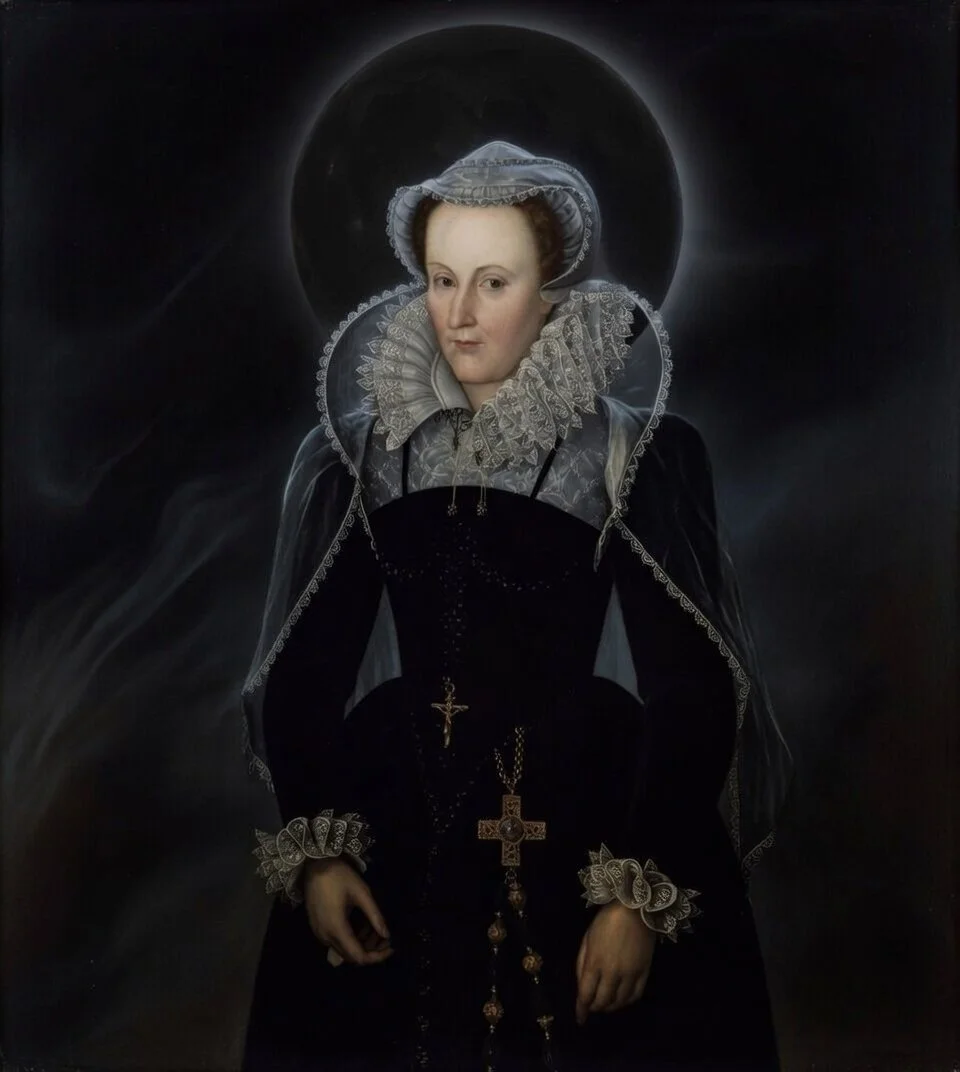
Mary Queen of Scots was born on almost fully Black Moon, 5th of December 1542 with only 4% illumination making her The Black Moon Queen energetically around Windsor Castle.
Mary, Queen of Scots, fiercely competed for the English throne while her cousin, the "Full Moon Monarch" Elizabeth I, already held it. Accused of multiple assassination plots against Elizabeth, Mary endured long years of imprisonment as a result. When viewing Windsor Castle's symbolic "full moon backup" alignment, it's clear which queen the castle "preferred": Elizabeth was born under a full moon, while Mary was born under a new moon (or "black moon"). These phases are inherently oppositional, so when forced to choose, the castle's full-moon energy naturally aligned with—and favored—Elizabeth, granting her the upper hand.
Queen Victoria – Empress of the Full Moon, Bride of the Black Moon

Queen Victoria was born on the 24 May 1819, the moon was in a New Moon phase (black moon with 0% illumination). Such a royal, heir to the throne, may find it difficult to take the throne at Windsor Castle luna focus, however on the day they become ruler, it is like another rebirth, and full moon on this particular day, certainly changed everything for her.
Queen Victoria ascended the throne, 20 June 1837, full moon where it was 98 to 94% illuminated. And no one contested her succession to the throne, unlike hundreds of years ago where Queen Mary and Queen Elizabeth, were both competing for the throne of England as we saw previously in the last paragraph (where Windsor Castle had a choice between two Queens).
However, Queen Victoria was born under a Black Moon (like Mary Queen of Scots), which brought significant opposition throughout her Full Moon reign. The Black Moon exists in natural tension with the Full Moon, much like opposing forces or adversaries.
When a person born under a Black Moon ascends the throne (becomes a leader) during a period governed by Full Moon energy — especially within a royal castle that strongly favours lunar fullness around heirship success — their reign can be exceptionally fortunate and powerful. Yet this same alignment often extracts a great personal cost or one has to go through some type of opposition like we saw with King Henry the Seventh (who has the same placement of two contrasting moons), for him to become King, he had to win a battle.
In Queen Victoria’s case, while her reign was historically great, her private life was deeply weakened. For her to become Queen under the same oppositional placement as King Henry the Seventh (Black Moon/Full Moon) she had to go against her mother who tried to steal power from her, by setting up a regency. It was another type of battle.
She also spent much of her reign as a widow and wore black for decades in mourning her husband, embodying the shadowed, sacrificial nature of the Black Moon.
Queen Victoria who ruled between 1837 to 1901. She held the throne longer than any other British monarch in history, for a very long time, lasting 44 years. Her reign was very successful being powerfully associated with industrial development, huge economic progress and as a rapidly expanding Empire. She expanded the borders of the British Empire significantly more than any other Monarch, conquering Canada and Egypt.
Under Queen Victoria, the British Empire was at its most prevalent and its greatest period. Her reign brought transport and communication, linking the world with one another for the first time in history. England went from a farming community to an industrial power. It was even said that she had the power to choose who the Prime Minister would be. In fact “at her death, it was said, Britain had a worldwide empire on which the sun never set”
There is no reference to a King in the history of Windsor Castle, ever being spoken of in a similar light.
It would be worth the royal family looking into preserving female line and not discouraging their existence.
In fact Queen Elizabeth II has already made this important move! Just before Prince William and Princess Kate produced a male heir, Queen Elizabeth, for the first time in history, changed the law to state that if a daughter was born first, that she had the right to rule and is a legitimate first in line to the throne.
King William the IV (Fourth): The Sailor King with a Double Moon Thin
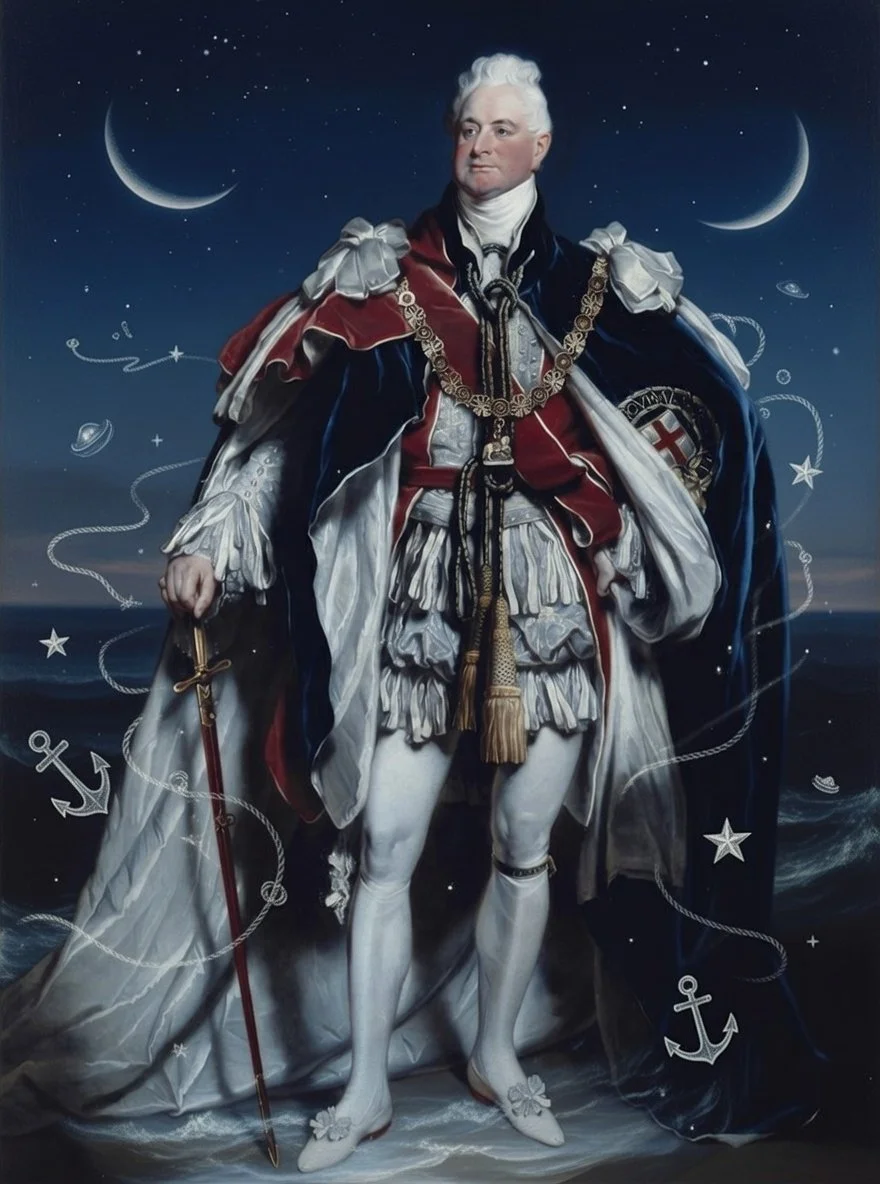
King William the Fourth was born on a cresent moon and in 1840 became king a weakly lite waxing cresent. His reign was only 7 years.
Who preceded Queen Victoria? It was King William IV, who apparently was not well liked and reigned for only seven years. Curious about this, I looked up the moon phases on his birth and day he succeeded as king—and both were quite “skinny” moons.
William was born on 21 August 1765, when the moon was a waxing crescent with only 20% illumination. On the day he became king, 26 June 1830, the moon was a waxing crescent at 31–35% illumination—still growing, yet still relatively weak.
This aligns with Windsor Castle’s preference for full-moon energy: it seems the castle did not favor him due to the weakly lit moons perhaps? Historically, William IV was known for erratic outbursts, awkward public speaking, and a lack of refinement, and his short reign reflects this mismatch with Windsor castle’s full-moon energy.
Although a short reign can still be prosperous nevertheless, I don’t think it was. His seven years on the throne were marked by the "Reform Crisis," economic hardship, and the violent upheaval of the Industrial Revolution. His coronation was known as the "Penny Coronation" due to his frugal nature.
King George III – The Double Full Moon Monarch: Long-Reigning Ruler, Haunted by Illness, Not Madness
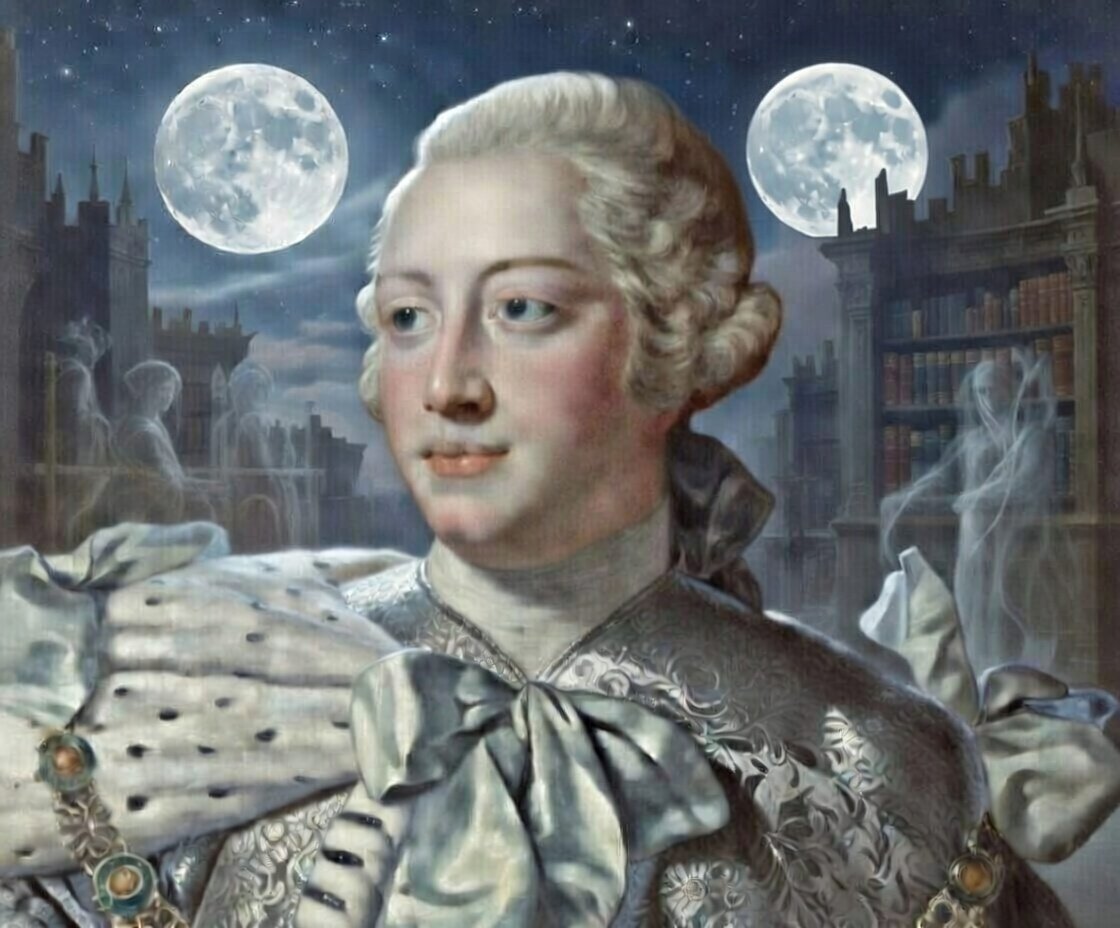
King George the III was born on a full moon and became King on one too lasting 59 years on the throne.
King George the Third, was born on the 4th of June 1738, which was a A Full Moon. However he became King on the 25th of October 1760 which was also a full moon with 98% illumination.
This makes him the Double Full Moon King like our own King in present times. Certainly which such a configuration, his reigned should be blessed in some way, also making him special indeed in some way or another.
In comparison to King William the Fourth, who had two thin moons, and who only ruled for 7 years, I’m suspecting George’s reign was longer or perhaps more fruitful than his? Am I right?
It is not surprising he endured one of British history's longest reigns, at 59 years on the throne, yet spent his final years confined beneath Windsor’s library, peering wistfully from windows during bouts of profound affliction, however I believe he was misunderstood.
While King George the Third in 1760 actually saw the monarchy relinquish direct control of lucrative lands, it established the modern, transparent system where the Crown Estate belongs to the monarch "in right of the Crown" but its profits go to the Treasury, with the monarch receiving a portion back as the Sovereign Grant.
In way, while he racked up huge debts, his reign brought in another main income source for the royal family, that has lasted over time, backing up the monarchy for generations - the Sovereign Grant.
It is said that he had seen ghosts in this location, of a women dressed in black, on a number of occasions.
History branded him "mad," but modern understanding reveals a tragic misjudgment—his episodes were likely severe bipolar illness, not mere lunacy. In death, his restless spirit lingers in that very chamber below the library, forever watching, forever misunderstood.
While his reign is associated with a loss of United States, he encouraged Captain Cook who helped discover and colonise Australia, for Britain.
Late Elizabeth II, the Growing Moon Monarch: A Reign of Steady Verdure and Timeless Harvest
Late Queen Elizabeth the second was born on 21 April 1926, where the moon was in its Waxing Gibbous (growing phase / 62% illuminated).
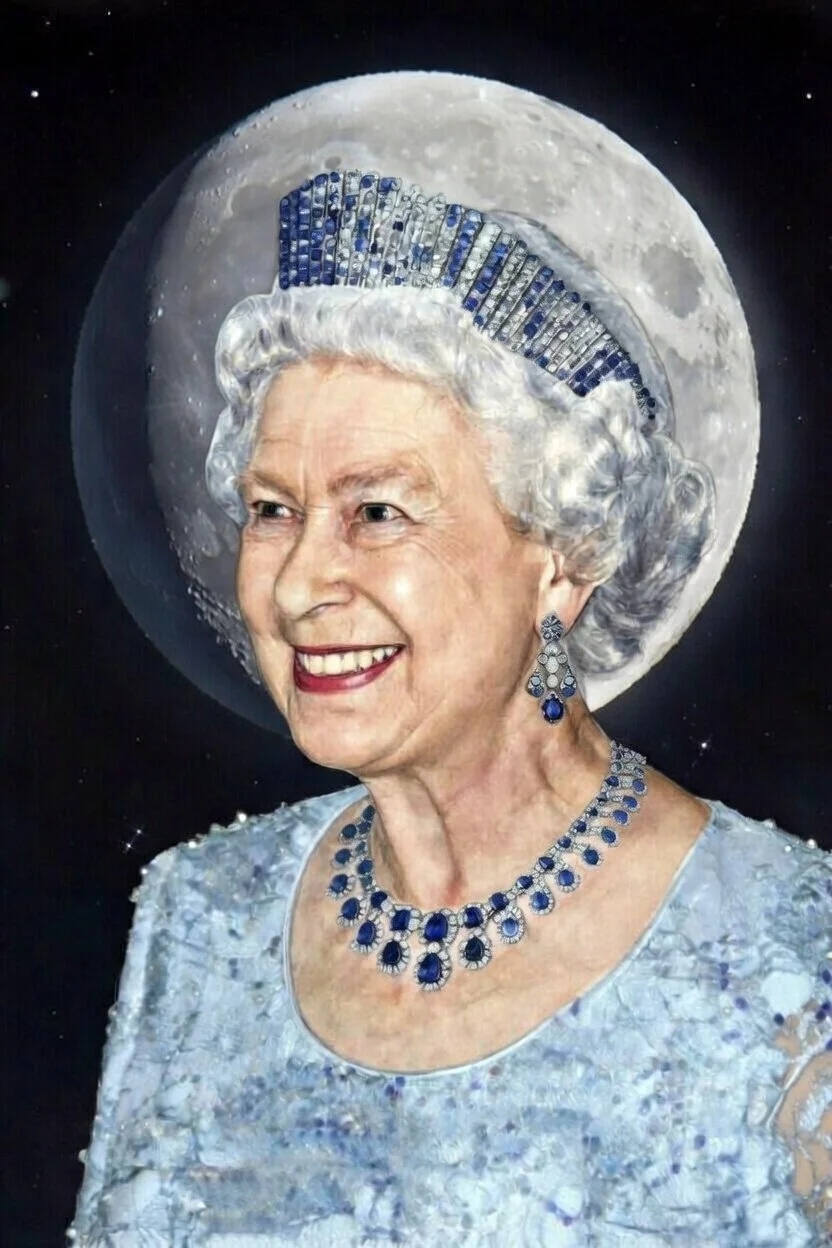
On 6 February 1952, the day Elizabeth II became Queen, the moon was in its growing Waxing Gibbous phase again yet a bit stronger (83% illuminated). Overall the fuller moon energy on the day she became Queen, enhanced her luck with the already female energies that Windsor Castle prefers.
Indeed, this almost full growing moon phase of 83% could back up the castle just as much as a full moon, if not more as the sitting direction tilts a little to the northwest, placing a little more emphasis perhaps to this moon phase which isn’t quite full, while more full moon’s could be still quite exceptionally supportive.
Though neither her birth nor her accession aligned with a perfect Full Moon, both occurred beneath notably full, waxing growing gibbous phases which are heading nearly towards a full one—strong enough to bestow enduring fortune, yet tempered by trials that forged resilience. The steady increase of the Moon at these pivotal moments foreshadowed a reign of gradual, organic expansion and unparalleled longevity: 70 years of steady growth, the longest in British history.
As both her moons for birth and reign, are very similar and not in opposition to one another, it symbolises a much easier time in ascending the throne, without much conflict, battle or opposition with someone else.
Edward the Eighth, the Black Moon Abdicating King!
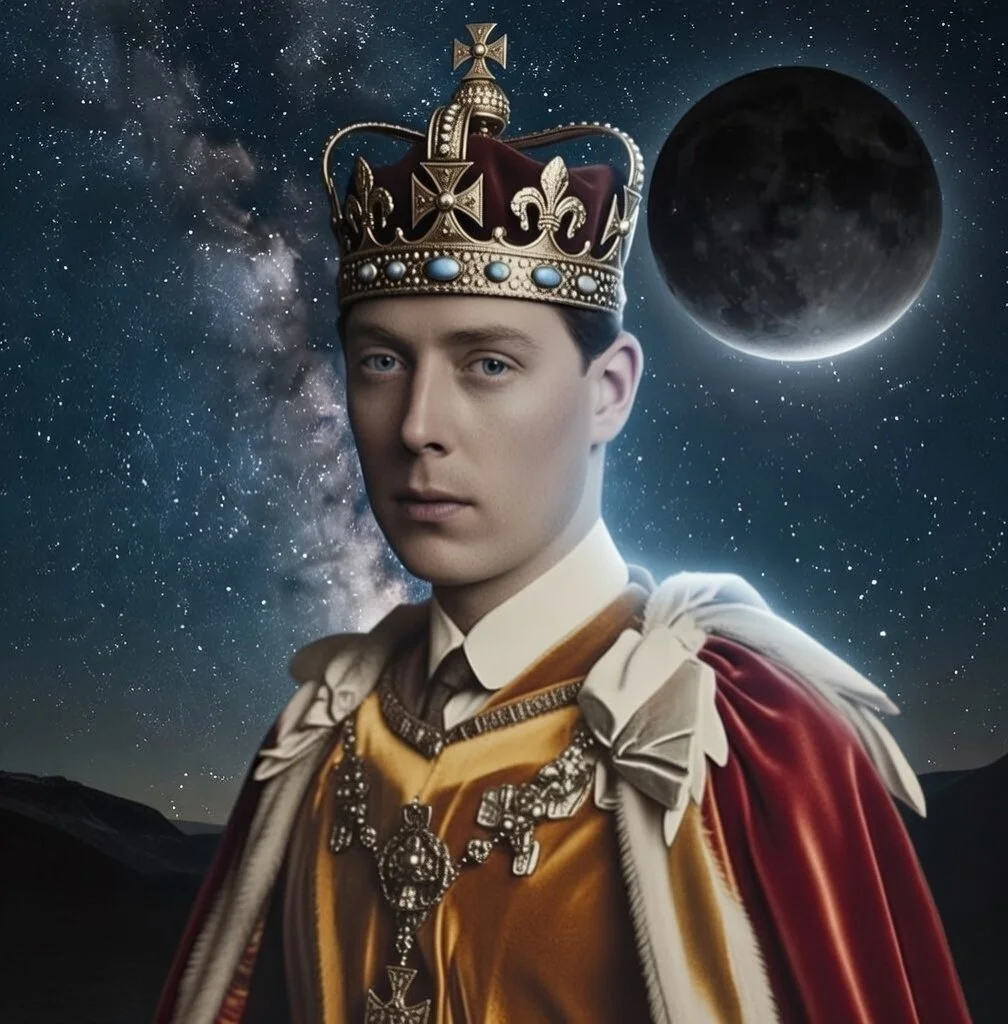
Became King on a skinny black moon which didn’t help him.
Another interesting royal to look at is King Edward the Eighth, who became King on a skinny almost Black Moon. It was a 17.72% illuminated wanning or declining crescent. Due to this aspect, it is quite intriguing that Windsor Castle Full Moon energies didn’t seem to back him up as he abdicated from the throne, which reflected this aspect. It is interesting that he was born on June 23, 1894 which was a fuller 80.32% illuminated moon (yet a declining moon not a growing one), yet the moon phase for when he became King (January 20th, 1936) was very weak and skinny, pushing him out of the castle (symbolically).
It seems that the Castle’s fuller moon placement was very sensitive to his lack of lunar presence!
King Edward VIII chose to give up the British throne in December 1936, mainly because he was determined to marry Wallis Simpson, an American divorcée whose two previous husbands were both still living. Her status as a twice-divorced woman sparked a profound constitutional and religious crisis within the British establishment, rendering it impossible for him to remain as monarch while pursuing the marriage.
His brother took his place on the 11 December 1936, King George the Sixth, which was on another black moon (another Black Moon King). He died 15 years later at a young age which was 56, which wasn’t a long time on the throne compared to his daughter, the late Queen Elizabeth, who was on it for 70 years after. During the last 4 years of his life, his health deteriorated and his reign, was marked by as a loss of an empire.
In contrast, King Charles III hasn’t been on the throne long, however he has lived a much longer life than King George the Sixth and his wealth has increased quite substantially. In comparison, the double full moon for his placement, suggests a much more nurturing energy around him.
Ladies of the Royal Family and their Moons..
Some of the women whom have come into the royal family are also beholding certain moon phases of interest, which are worth noting.
For example, the late Princess Diana was born under a near–full moon (90% illumination) on 1 July 1961. However, her marriage took place under a black moon on 29 July 1981. As the black moon stands in opposition to the full moon, the marriage appears symbolically opposed to her birth moon and, therefore, not fated for lasting success. Despite this, Diana gained immense public prestige, becoming known as the “People’s Princess.” In this sense, Windsor Castle still seemed to confer full-moon fortune upon her, blessing her with enduring popularity and status that did not fade
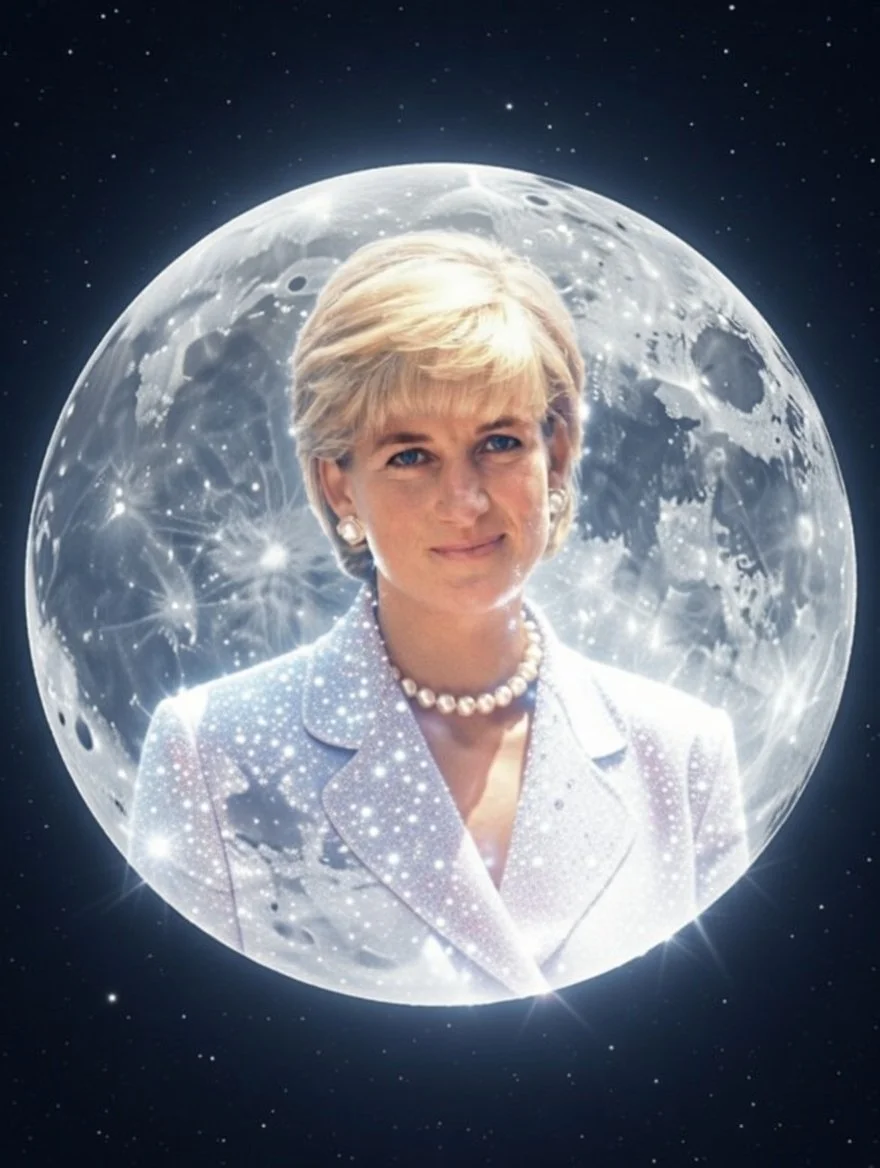
Princess Diana was born on a full moon similar to Queen Elizabeth The First
The Duchess of Sussex was born on a near or almost black moon on the 4th of August 1981. This is a very powerful moon phase similar to Mary Queen of Scots, who was considered quite powerful and a Queen in her own right.
In fact, it can be argued she was true Queen of England by many, yet was present when another Queen, of a full moon status, was already around Windsor Castle and had a claim on the throne. That was Queen Elizabeth the First. It suggests a timing of opposition around polar opposites.
The Duchess of Sussex’s move to the US is symbolic of this power play although a much watered down version of it, in modern times. I’m not implying that she was in opposition to anyone, only that the moon’s phase was symbolic of the energy around her during the time and the challenges she faced.
Black moons can attract significant wealth to the monarchy it seems, as seen with Queen Victoria, who was also born under a Black Moon, she faced little opposition (as no one else qualified to take it and their were lack of male heirs) and she ascended the throne without opposition.
The castle appears to continue lending its fortune at key times, as a Queen born under a Black Moon, seemed to benefit greatly from its influence when paired with a Full Moon on the day she became Queen, bringing immense wealth and expansion to Britain during Victoria’s reign.
King Henry the Seventh also was born on an almost Black Moon and became King on a near Full Moon, as spoken about earlier, he brought in expansive wealth where he prospered in an outstanding way.
This suggests that the integration of both contrasting moons in the one person, can significantly enhance an individual’s power it seems.

Duchess of Sussex was born on a close almost black moon similar to Mary Queen of Scots
Princess Catherine, born under a Full Moon lunar eclipse on January 9, 1982, carries energies that resonate deeply with the full moon aligned over Windsor Castle. From a spiritual perspective, this powerful synchronicity helps explain why her connections within the royal family have steadily deepened and strengthened over the years—her essence mirrors the Castle’s heightened lunar presence.

Princess Catherine was born on a full moon luna eclipse
You do not have to be born on a or near a full moon or a black moon to become famous, well known or have success. For instance Angelina Jolie was born on the 4th of June 1975, with a wanning crescent moon, only 23% illuminated.
I feel astrology can only achieve a certain parameter, and looking at important buildings are also key in determining the luck of individuals in a symbolic way, while they reside there, such as we see here with Windsor Castle, its full moon status and the outcome of its occupants over time, suggestive of its influence perhaps.
As a summary below, one can see all at once the Full Moon and Black Moon at play around female royals at the castle and the effect of ‘power of opposition’:
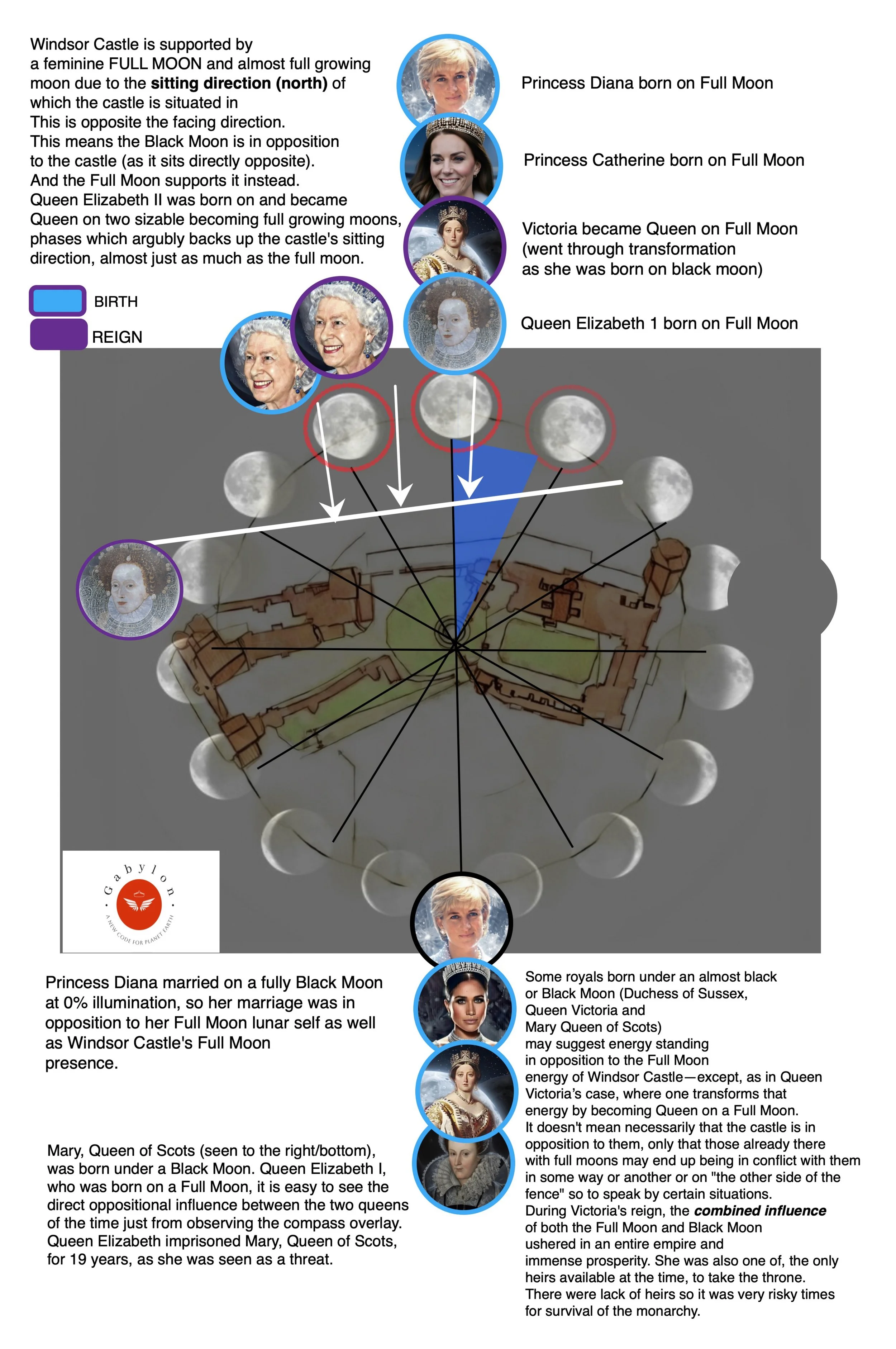
Royal females of interest at Windsor Castle.
It is interesting to note that the late Queen Elizabeth the Second, had two growing moons, one for birth and the other for becoming Queen upon death. To have such similar moons is suggestive of a much more smoother accession to the throne than one faced by opposition like Queen Victoria (with a Black and Full moon) who was up against her mother and King Henry the Seventh (with also a Black and Full moon) where he had to win a battle to become King.
Certain influential buildings, such as Windsor Castle, appear to symbolically reflect the interplay between key individuals, influenced by their birth timing, when they became Queen at death, and the combined effects on those around them. In this context, Windsor Castle’s association with a Full Moon or nearly full growing moon seems significant. This symbolism is particularly evident in some of the most notable long-reigning female monarchs: Queen Elizabeth I, born under a Full Moon; Queen Victoria, who became Queen on a Full Moon; and Queen Elizabeth II, whose reign coincided with two substantial growing moons (birth and becoming Queen when the previous ruler passed).
Male rulers of interest summarised visually below:
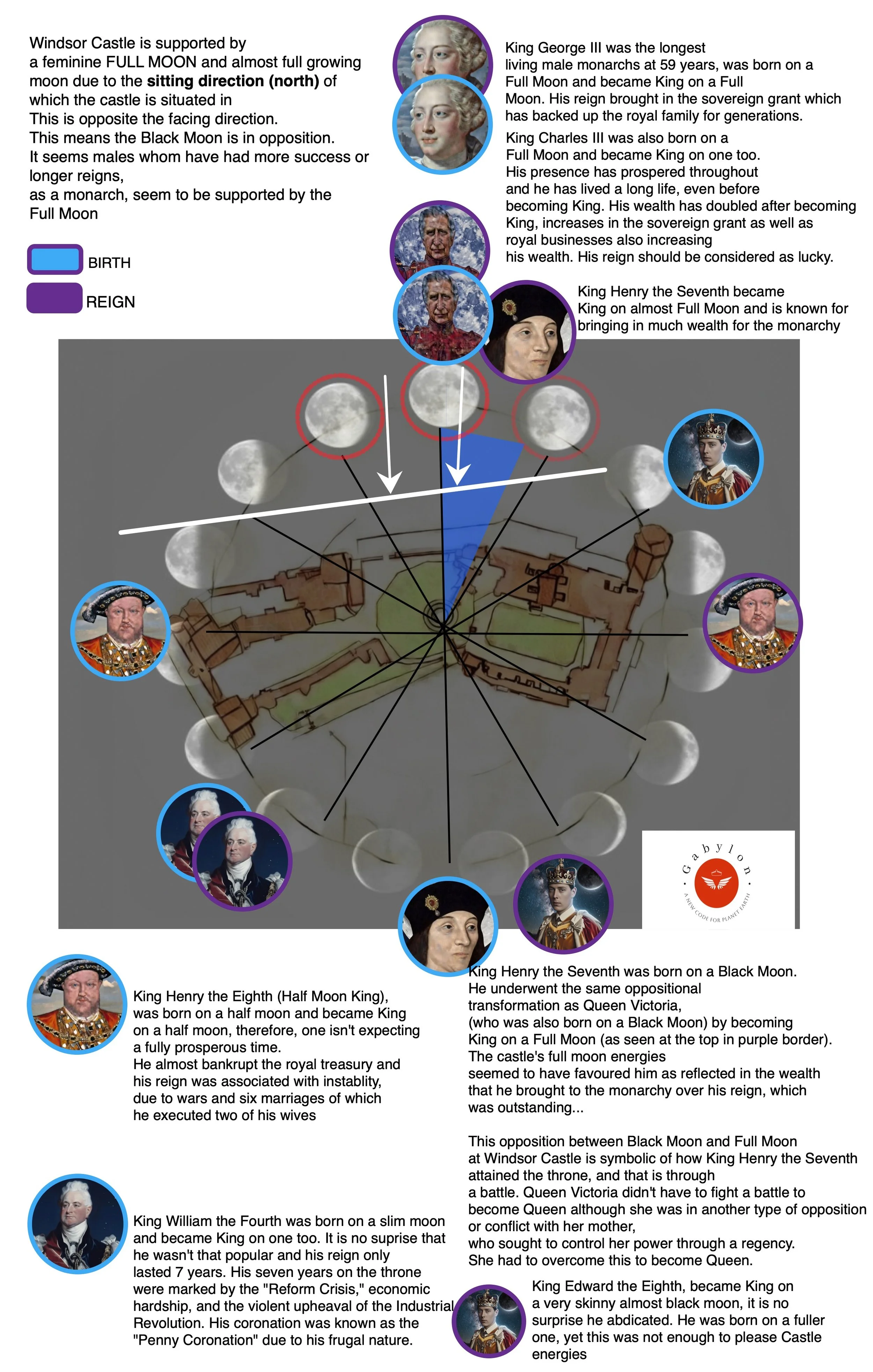
Male rulers of interest at Windsor Castle
In Summary:
The two diagrams present a symbolic, astrological framework suggesting that Windsor Castle is energetically aligned with — and "supported" by — a feminine Full Moon influence due to its northward sitting orientation (backup direction). This Full Moon presence is said to favour royals born on becoming ruler on the day of passing, during Full Moon phases (especially queens like Elizabeth I, Victoria, Elizabeth II, and consorts/princesses like Diana and Catherine), associating them with stability, prosperity, popularity or transformative success.
In opposition stands the Black Moon, linked to figures born under it (e.g., Henry VII, Mary Queen of Scots, some modern royals) who often faced direct conflict, imprisonment, or rivalry with Full Moon-aligned powers — yet certain individuals (Victoria, Henry VII) undergo a "transformation" by later acceding on a Full Moon, harnessing the castle's supportive energy to achieve wealth, empire, or long-term dynastic strength. Male monarchs born or crowned on Full Moon (George III, Charles III) tend to experience prolonged reigns, doubled wealth, or luck, while those tied to half-moons or weaker phases (Henry VIII, William IV) face instability, bankruptcy, short reigns, or unpopularity — framing royal power plays, success, and conflict as a cosmic tug-of-war between these lunar polarities overlaid on the castle's architecture.
In the Centre of Windsor Castle grounds, we find the Middle-ward also called the Round Tower.
Beyond attracting and being supported by full-moon energy, the grounds themselves pay homage to this symbolism through the Tower’s circular construction, which embodies the full moon.
This is where the Constable or Governor whose office is military one was located. He would also issue executions. His position was to defend the castle against enemies. The are many military items decorating this Middle-ward, quarter pikes, breast plates, helmets, daggers and pistols. The Round Tower is the tallest building of Windsor Castle grounds.

Vulnerable Spots of Windsor Castle during 2015 and Connections to the 1992 Fire Incident!

For the weaker or more vulnerable areas of Windsor Castle in 2015, focus on the North-East section, where the State Apartments are located. In ancient Imperial China, the Emperor would regularly change his sleeping quarters every few years to align with the most favorable direction for that time.
He always avoided the "Direction of Opposition" for the year, as it brought negative energy. Each Chinese zodiac animal is linked to a fixed direction on the compass. In 2015—the Year of the Goat (or Sheep)—the Goat governs the South-West. This made the South-West of any building highly activated, auspicious, and energized that year. The direction directly opposite the Goat on the compass is the Ox, which falls in the North-East.
This "Opposition" sector becomes vulnerable: it often attracts instability, accidents, or setbacks, creating a weak spot in the building's energy. At Windsor Castle, this North-East Opposition direction is precisely where the State Apartments sit. Looking back to 1992—another Year of the Goat (23 years earlier)—the State Apartments in this same North-East Opposition sector suffered a massive fire.
The blaze started on 20 November 1992, destroyed 115 rooms (including nine State Rooms), and required years of major restoration. This historical event supports the idea that the North-East can be a risky area during Goat years.
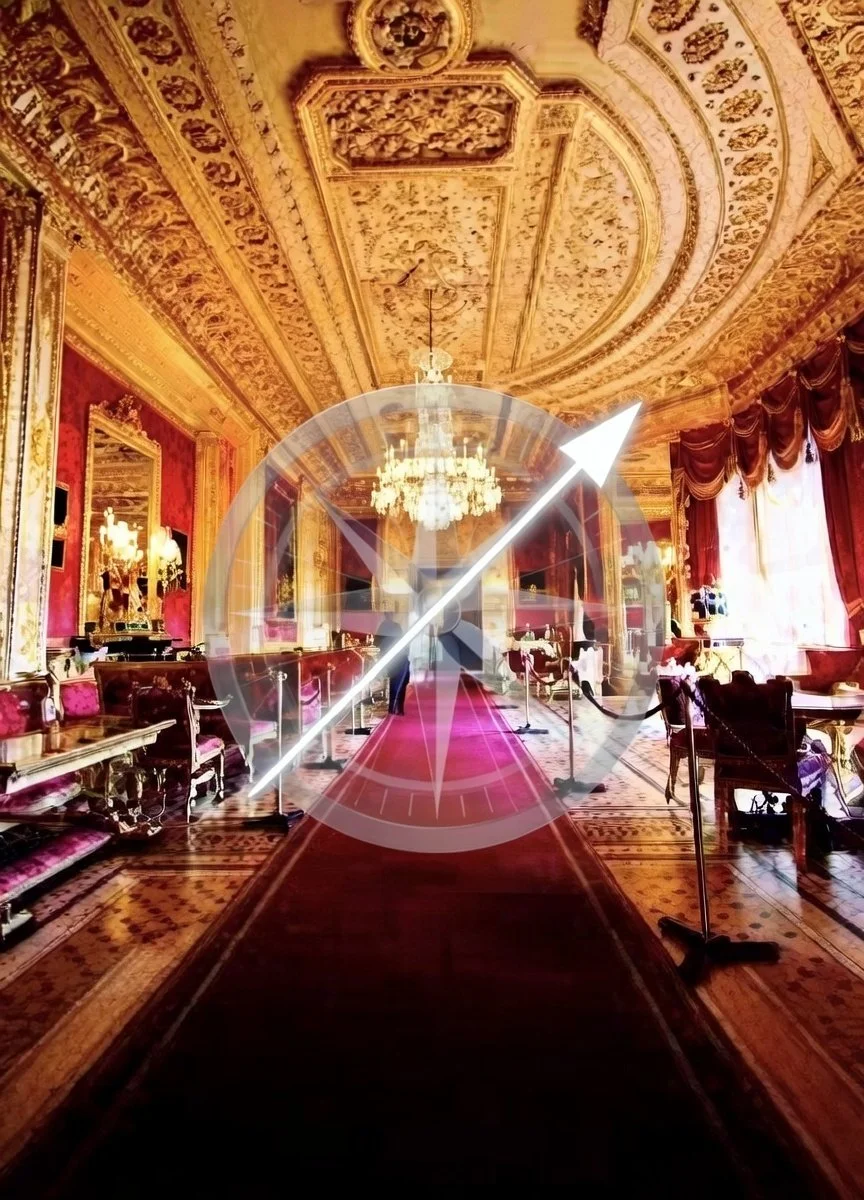
Crimson Drawing Room at Windsor Castle, image available at this link > Wikipedia
Ghosts in the Royal Library, Yin Energies and the Colour Black
Windsor Castle is considered the most haunted castle out of all the royal castles, with 25 cases of reported ghost sightings at this castle alone.
Ghosts should not be considered a bad thing or negative occurrence at Windsor Castle, as ghosts are part of the double 2-2 combination in the sitting direction backing up the throne, their presence would only be to back up the throne and support it as well. It would be rather unlucky to try to get rid of them or discourage their presence.
Because of such a strong Yin energy dominating the Castle grounds, a ghost could be seen in any area. However, after looking over the Castle grounds, in my opinion, the most prevalent area for a ghost to appear would be in the North Sector. This sector which is also about the moon is also about night time and the dark hours.
One building in particular that overlaps this area of Windsor Castle Grounds, is the Royal Library. After doing some research I discovered that there have been some reported sightings of a ghost often appearing in this library, but it is not the ghost of any royal, it just so happens to be the ghost of Queen Elizabeth the First who was regarded as the greatest monarch that ever ruled England. It has also been reported that she has been seen wearing black.
About a century later, King Edward VIII reportedly encountered a ghost he described as a woman in black who strikingly resembled Queen Elizabeth I. His brother, King George VI, claimed to have seen the same apparition—Elizabeth I—on eight separate nights in the library, just before the outbreak of World War II. More recently, Queen Elizabeth II and her sister, Princess Margaret, are said to have witnessed the ghost of their Tudor namesake in the Windsor Castle library as well.
Overall Summary
As someone deeply attuned to the subtle energies of places like Windsor Castle—through my own lens of Feng Shui and lunar cycles—I've come to see the full moon's influence as a powerful equalizer, even in a space that so strongly favors feminine rulership.
The castle's North sitting direction, tied to that pure Lake 1 segment and the full moon's peak illumination, creates a magnetic pull toward yin qualities: intuition, receptivity, nurturing authority, and often greater prosperity for the monarchy under Queens. History shows this pattern clearly—Queens like Elizabeth I and Victoria drew in "Golden Ages" of wealth and empire, while many Kings faced instability or financial drains.Yet, I firmly believe Kings can thrive here when the full moon aligns closely with their personal chart or key moments. It's not impossible; it's conditional and rarer, but potent when it happens. Take Henry VII: he ascended on an almost-full moon (around 86% illuminated), and that lunar backing helped him build immense royal wealth, setting up his son's reign beautifully. Or look at King Charles III today—he was born just before a full moon, and his ascension came under very strong lunar influences too. His personal fortune has reportedly grown significantly compared to recent predecessors, suggesting the castle's full moon energy is actively supporting him in ways that emphasize stability and accumulation rather than volatility.
In my view, the full moon doesn't reject male rulers outright—it simply demands harmony. A King with strong lunar placement (birth near full, ascension on a bright moon, or even blue-eyed resonance with the northern water energy) can tap into that same supportive flow. It amplifies leadership when aligned, turning potential opposition into alliance.
The castle "backs" the throne like a spine, and for those Kings who sync with its lunar rhythm, it can provide extraordinary luck, wealth, and longevity—proving the energy is inclusive for those who resonate with its feminine, moonlit essence. Queens may have the natural edge, but a well-timed full moon can make any sovereign shine at Windsor.
By Feng Shui Master Gabriella
This Article on Windsor Castle is Officially Copyright Protected © 2026